 Sapere.
Sapere.
Sapere.
The one honest answer
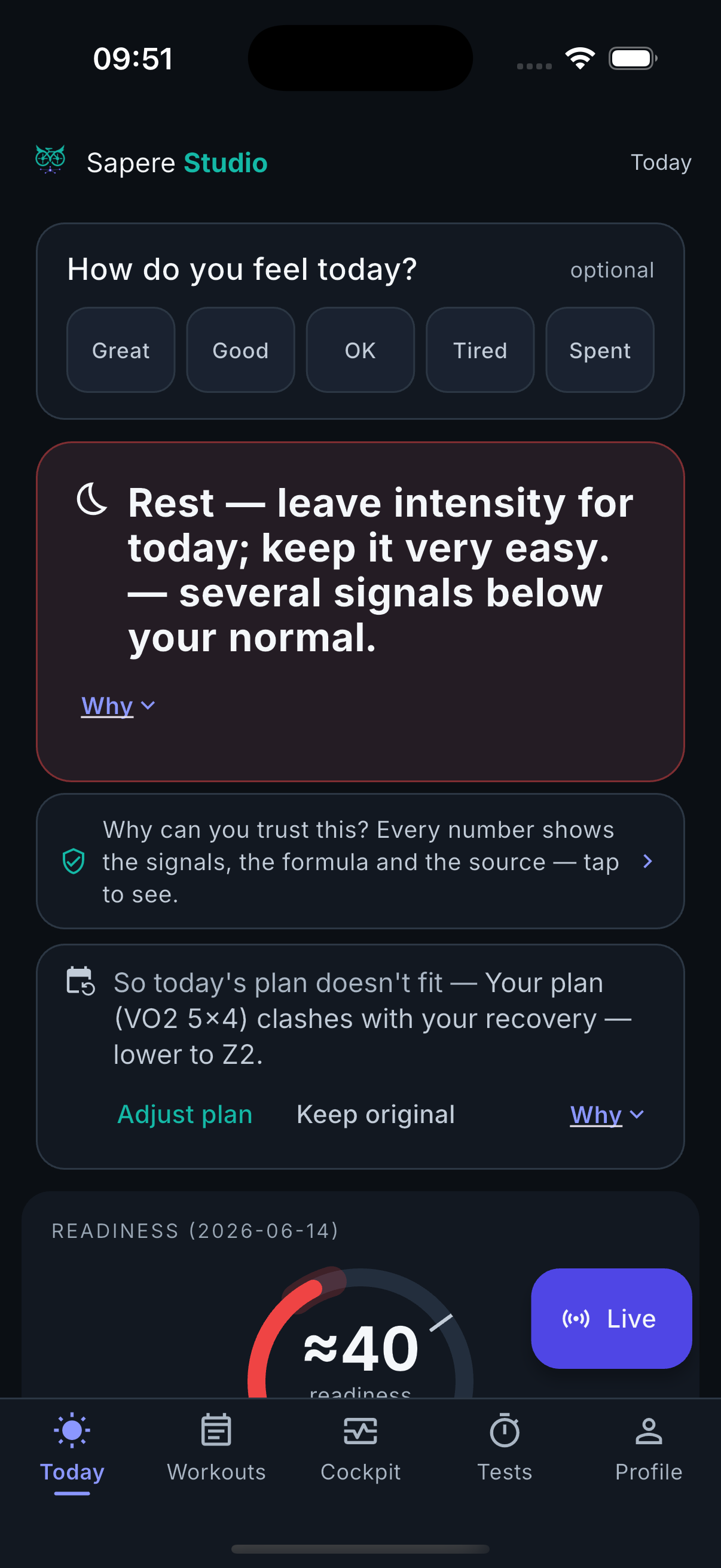
You open your training app, see a readiness score of 67 — and still don’t know whether to do today’s intervals. Sapere does the weighing — your training load, your planned workout, and your own sense of the day — and answers in plain language, with the reasoning one tap away.
Your load and form come from the standard impulse-response model — fitness (CTL), fatigue (ATL) and form (TSB) as exponentially-weighted averages of your training stress. Your readiness blends recovery signals (heart-rate variability, resting heart rate, sleep) against your own rolling baseline, using robust z-scores so one odd night doesn’t skew the call. Build-up is read from your ramp rate and TSB — not a single risk ratio.
Sources: Banister (1991) impulse-response · Coggan / TrainingPeaks (CTL·ATL·TSB).A non-medical attention signal from training & wellness data — it does not detect, diagnose or predict illness. A training & wellness tool, not a medical device.
Show, don’t tell
Two registers, one set of facts
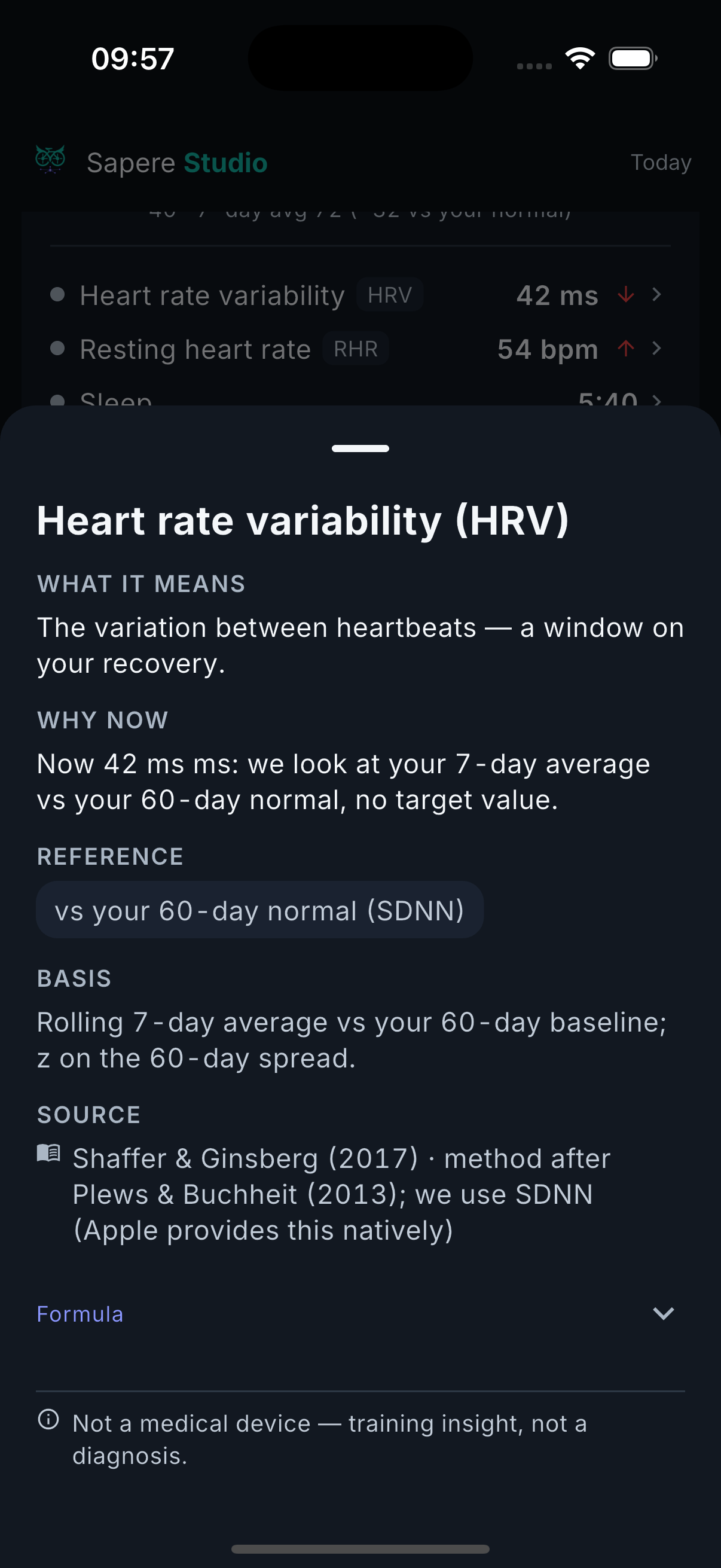
A decoupling of 1.17% or an EF of 0.767 means little on its own. Above the numbers, Sapere writes what it means in plain language. Tap through and you get the same finding again, for a coach: the rule of thumb next to it, and the exact window of the ride it was measured on.
Plain language: “A textbook Z2 ride. 92% of the time in zone, power close to flat (VI 1.01). Your heart climbed 6 beats at the same power — normal heat drift on the trainer.”
For the coach, one tap away: decoupling 1.17%, measured on minute 20–55 — warm-up and cool-down trimmed first, because an aerobic-coupling read only means something once heart rate has settled. Under 5% counts as well-coupled. If intervals.icu’s own number differs, it’s shown next to Sapere’s — never swapped in for it.
Every finding like this carries a fact, an optional rule of thumb, and where it comes from — the app never states one without the others.One rule-based engine writes both registers today — no AI in the loop. Every threshold it uses (a decoupling under 5%, a variability index under 1.05, an aerobic-base trend that needs at least six comparable rides) sits in code next to a test that pins it, so a wording change can never quietly move where the line is drawn. A more conversational, paid voice is designed to sit alongside this engine later — but it is only allowed to rephrase the same facts and thresholds, never to draw its own conclusion. A paying reader gets nicer language, not a different truth.
One thing it never does: attach a rule of thumb to a readiness or HRV finding. Those describe your recovery, and stay strictly descriptive — no norm, no verdict.
The full circle
Studio, Sistema and Salita aren’t four separate products you juggle — they’re one loop around intervals.icu. Every ride feeds it, and every ride reads back sharper than the last.
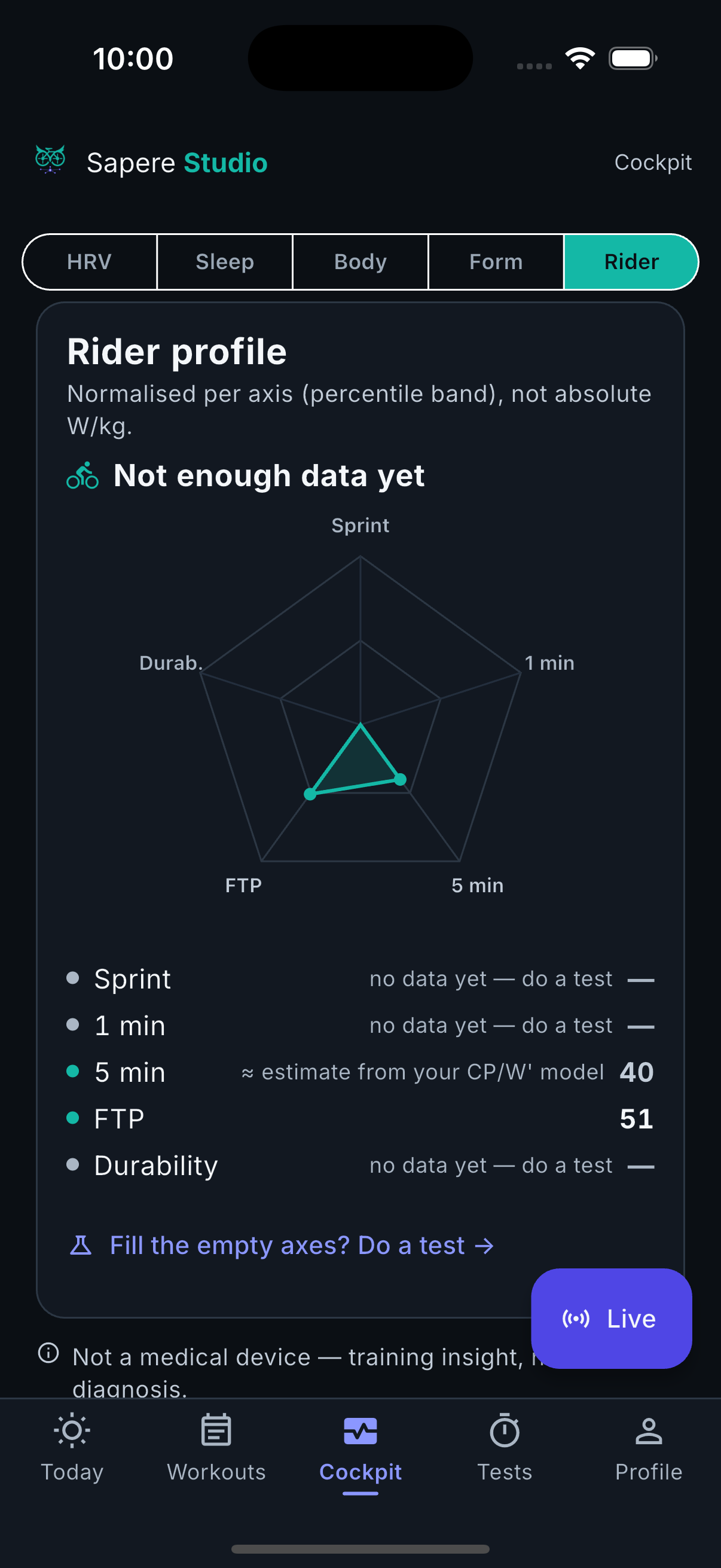
No power meter? You still get Strada and the daily go / ease / rest. With a power meter the loop closes: your CP test writes your W′ to intervals.icu, your zones are right everywhere, and Scorta reads a real number on the bike — not an ≈ estimate.
Garmin data fields (Sistema · Salita) are in testing — not yet in the Connect IQ store. Today the loop runs on Studio + intervals.icu.
Your coach is digital
No surprises. Here is exactly what it takes to start.
No paid tier needed. intervals.icu is a free training log — if you ride with a Garmin, your data is probably already there.
intervals.icu is free — sign up in five minutes and your rides are ready.
Strada mode works without one — speed, gradient/VAM, wind and HR. Storia and Scorta add up once you have a power meter.
Everything below runs today — on a real Edge 1050 and a real iPhone. None of it has been submitted to a store yet. When that changes, this list changes with it.
In testing Studio — iOS coach on intervals.icu, including Apple Health recovery signals
In testing Sistema — Garmin Edge data field, validated on an Edge 1050
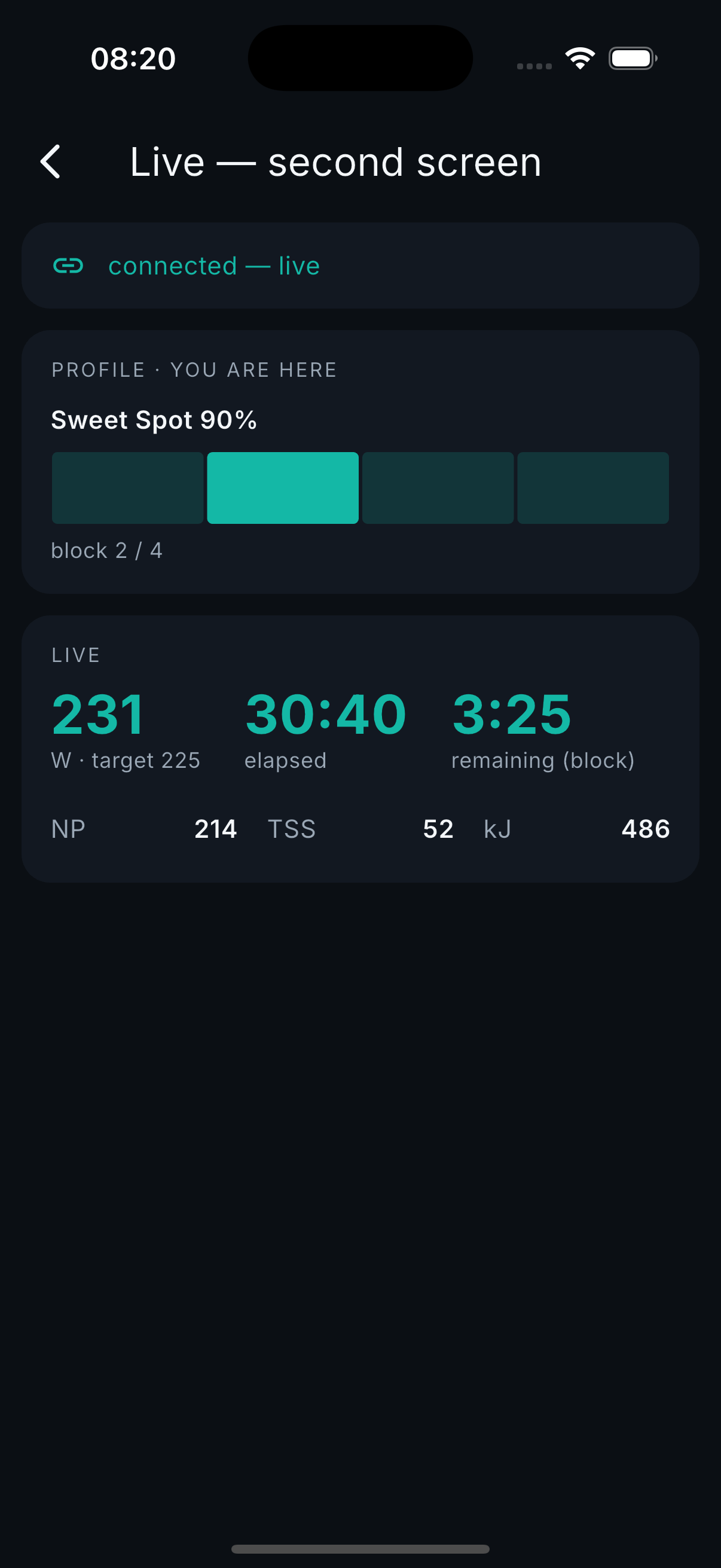
In testing Salita — indoor trainer app
Sapere is a training & wellness tool — not a medical device. It does not diagnose, treat or predict illness, and does not give medical advice.